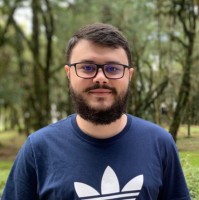
Bachelor in Architecture and Urbanism from the Federal University of Espírito Santo (UFES), Brazil, in 2012, and obtained a Master's degree from the same institution in 2015, with internship at Università degli Studi di Firenze (UNIFI), Italy. He earned a PhD in Architecture and Urbanism (Geodesign) from the Federal University of Minas Gerais (UFMG), Brazil, in 2019, with an Erasmus Mundus scholarship at the Technische Universität Wien (TUWien), Austria.He completed a Postdoctoral Fellowship (2019-2020) in Digital Participation at University College Dublin (UCD), with the EU project Coastal Communities Adapting Together (CCAT). Currently, he is a Researcher (2023-2024) at REMIT - Research on Economics, Management and Information Technologies, in the Department of Architecture and Multimedia Gallaecia (DAMG) at the University of Portucalense (UPT), Portugal, funded by the Foundation for Science and Technology (FCT), developing the project “Heritage in Play: Education and Impact Assessment in Sustainable Heritage Management.” Between 2020 and 2022, he served as an Assistant Professor in the UNESCO Chair on Heritage and Values at Delft University of Technology (TUDelft), Netherlands. His experience encompasses the application of digital and analog technologies in the planning, design, and management of architectural, urban, and landscape heritage in contexts such as Brazil, Italy, Austria, Ireland, the Netherlands, and Portugal, with an emphasis on citizen engagement through serious and educational games and augmented reality.His focus includes the application of digital technologies for: 1) training architects with skills in graphic, interactive, and playful project representation grounded in cultural significance; and 2) promoting participatory democracy in heritage management processes in the face of climate change.Currently, from 2024 to 2026, he collaborates with the EtniCidades research group at the Faculty of Architecture of the Federal University of Bahia (UFBA), co-coordinating the project “Preserving Legacies: A Future To Our Past” in Salvador, in collaboration with ICOMOS International, the National Geographic Society, and the Climate Heritage Network, aiming to develop a collaborative conservation and climate adaptation plan for the eight Candomblé Terreiros listed by IPHAN.Keywords: geogames, serious games, values-based design, game design, heritage education, collaborative heritage management, cultural mapping, gamification, climate risk assessment, climate adaptation planning, Artificial Intelligence (AI) in heritage preservation.