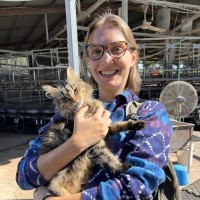
Phd Candidate
My research investigated the unique reproductive biology of the short-beaked echidna.Outcomes:1. Using EIA of plasma progesterone, I characterised gestation and the luteal phase; 16 and 15 days, respectively. 2. Using detailed observations of pouch morphology, I confirmed that the pouch only develops during pregnancy and created a four-stage grading system to describe this. 3. I developed a safe, low-impact faecal marking protocol that spiked food colouring powder into echidna’s regular feed to identify an individual’s faeces amongst mating partners contained in the same enclosure. 4. Using daily faecal samples collected from eight females over three breeding seasons, I found progesterone concentrations were elevated above baseline during pregnancy and the luteal phase, offering a non-invasive means of hormone monitoring.5. I identified ‘characteristic’ behaviours of breeding pairs and pregnant females indicating copulation and oviposition, respectively. I also identified two new, previously unrecognized oestrus behaviours: standing oestrus and rump presentation.6. I investigated seasonal changes in adiposity and the role of the adipostatic hormone leptin. Using MRI and DEXA scanning technologies, I found echidnas demonstrated an annual cyclical nature of body fat storage. Interestingly, leptin concentrations from serial plasma samples did not correlate with adiposity suggesting that unlike other mammals, an alternate pathway could control this mechanism. Collectively my thesis enhanced our understanding of echidna reproductive biology and significantly contributes to improved captive husbandry practices. This will not only broaden our knowledge of monotreme biology but also improve assisted reproductive technologies that can sustain critically endangered species.