
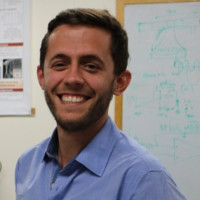
AeroLeads people directory · profile
George Alexopoulos Email & Phone Number
Graduate Research Fellow
at
Stanford University
1 work email found
@stanford.edu
LinkedIn matched
✓ Verified August 2026
4 data sources
Profile completeness 86%
Current company
Role
Graduate Research Fellow
Location
Stanford, California, United States
Who is George Alexopoulos? Overview
A concise factual answer block for searchers comparing this professional profile.
Quick answer
George Alexopoulos is listed as Graduate Research Fellow at Stanford University, based in Stanford, California, United States. AeroLeads shows a work email signal at stanford.edu and a matched LinkedIn profile for George Alexopoulos.
George Alexopoulos previously worked as Course Grader at Stanford University and Course Assistant at Stanford University. George Alexopoulos holds Doctor Of Philosophy - Phd, Electrical And Electronics Engineering from Stanford University.
Company email context
Email format at Stanford University
This section adds company-level context without repeating George Alexopoulos's masked contact details.
{first}.{last}@stanford.edu
86% confidence
AeroLeads found 1 current-domain work email signal for George Alexopoulos. Compare company email patterns before reaching out.
Profile bio
About George Alexopoulos
Stanford PhD Candidate and Research Fellow in Dr. Ada Poon's lab. 8 years of research experience in RF/electromagnetic circuit and system design and measurements. 3 years of research experience in passive sensing systems, coupled resonator electromagnetics and circuit design. 3 years of research experience in biomedical systems/imaging, information theory, and multiphysics approaches combining electromagnetics and ultrasound. Heavy experience with HFSS/ADS/circuit simulators and measurement instrumentation including VNAs, PNAs, spectrum analyzers, oscilloscopes, load/source pull equipment, amplifiers, waveform generators, etc. Looking for internship/part-time opportunities in RF and Microwave design/engineering for aerospace, biomedical, and/or IoE applications.
Current workplace
George Alexopoulos's current company
Company context helps verify the profile and gives searchers a useful next step.
10 roles
George Alexopoulos work experience
A career timeline built from the work history available for this profile.
Graduate Research Fellow
Stanford Integrated Biomedical Systems (Dr. Ada Poon)• Investigating the application of quantum mechanical concepts such as parity-time (PT) symmetry and multi-resonator theory to achieve high-degree-of-freedom, multiple resonant mode (frequency) electronic coupled-resonator systems for wireless readout and actuation• Mathematical modeling and solving of electronic coupled multi-resonator system response• Broadband (DC to low mm-Wave) electromagnetic modeling and optimization of capacitive and inductive coupling methods in the presence of dielectric media in HFSS and CST• Modeled and designed real-time, coupling-insensitive wireless resistive sensing system using nonlinear PT symmetric electronics• Co-authored chapter reviewing and analyzing the performance and sensitivity of state-of-the-art wireless readout techniques in biomedical applications• Leveraging coupling-insensitive characteristics of nonlinear PT-Symmetric electronics in matching networks• Design and modeling of capacitive stimulation/actuation system for chip-in-cell applications• Design and modeling of high-order, high-frequency, PT-Symmetric, multi-electrode sensing platform for chip-in-cell applications in Cadence and HFSS
Course Grader
• Summer 2018: ENGR 040M• Fall 2018: EE 315• Fall 2018: EE 242• Winter 2019: EE 252• Spring 2019: EE 101B• Fall 2019: EE 242• Spring 2020: EE 101B• Fall 2020: EE 242• Winter 2021: EE 225
Course Assistant
• Taught topics in graduate electromagnetics including optical waves in layered media, guided waves, electromagnetic computation, and electromagnetic radiation for one quarter under Professor Jonathan Fan • Taught in an online-only format during the Fall 2020 quarter• Received average rating of 4.1/5.0 on student-based course evaluations
Sep 2020 - Dec 2020
Course Assistant
EE 303–Autonomous Implantable Systems• Taught topics in implantable devices including sensors, energy harvesting, stimulation/actuation, and applications for two quarters under Professor Ada Poon • Taught in an online-only format during the Spring 2020 quarter• Received average rating of 4.3/5.0 on student-based course evaluations
Mar 2019 - Jun 2020
Course Assistant
EE 216 - Principles and Models of Semiconductor Devices• Taught semiconductor device topics including material and energy band physics, PN & MS diode physics, optical devices, and transistor physics for two quarters under Professors James Harris, Roger Howe, and Eric Pop • Designed and graded problem sets and midterm/final exams• Taught and reviewed course topics in weekly office hours and review sessions recorded live by the Stanford Center for Professional Development (SCPD) for more than 50 on-campus and remote students• Received average rating of 4.5/5.0 on student-based course evaluations
Sep 2017 - Mar 2018
Graduate Research Fellow
DC-Terahertz Group (Dr. Amin Arbabian)• Designed microwave non-contact thermoacoustic tracking system for medical interventional devices• Optimized microwave power deposition in biological tissues through HFSS and ANSYS Multiphysics packages• Performed dielectric characterization of human phantom materials• Created a 2-D trilateration setup achieving mm-scale tracking accuracy using an array of CMUTs (capacitive micromachined ultrasound transducers) to detect the location of the device in a human tissue phantom• Modeled 3D pressure wave generation and propagation through the Matlab k-wave toolbox• Performed signal analysis using short time FFT, cross-correlation, and other signal processing techniques• Worked extensively with laboratory/measurement equipment including signal generators, power amplifiers, oscilloscopes, VNAs, as well as protocols for measurement acquisition and control
Sep 2015 - Sep 2017

Electrical Engineering Intern
• Worked under the supervision of Dr. Mazhareddin Taghivand and Dr. Kamal Aggarwal• Analyzed performance of polar vs Cartesian (I/Q) transmitter architectures for low PAPR and high power efficiency applications• Designed a full-scale TX radio for low output power IoT/WiFi applications• Achieved high-efficiency performance for full transmit chain including D/A conversion• Trained extensively with IC schematic and layout tools in Cadence including PeakView for transformer/transmitter co-design
Jun 2019 - Oct 2019

Undergraduate Research Assistant
• Developed fully automated system in NI LabView to measure & optimize antenna gain vs. spatial orientation• Learned calibration techniques, measurement setup, and load/source-pull measurements on Maury ATS and IVCAD software for NSF-funded research on microfluidics in power amplifier design• Developed ADS and HFSS simulation models for frequency-tunable matching networks over microfluidic channels on organic substrates for a class-A power amplifier design• Designed and created photolithography masks in HFSS & ADS for wideband hybrid encapsulated package integrating multiple semiconductor and interconnect technologies on one organic platform• Designed wideband (2-20 GHz) Wilkinson Power Divider and Balun for 1×4 dipole antenna array in HFSS
May 2011 - Jun 2015
Residence Assistant
• Patrolled and monitored over 6 different residence halls for safety and security.• Planned and executed programs based on Institute learning goals (personal development, professional development, community development, service, and cultural development) for mostly freshman residents. Examples include political discussions during the 2012 elections, intramural sports, visits to Atlanta locations such as the Shakespeare Tavern, the High Museum, Phillips Arena, etc.• Planned and executed community service opportunities such as Tech beautification Day, Game Day Recycling, Tech Day of Service, City of Refuge Homeless Shelter, etc. with the goal of allowing residents to connect with and help people outside of their socioeconomic status.• Residence Assistant of the Year (2012-2013)
Aug 2011 - May 2015
3 education records
George Alexopoulos education
Doctor Of Philosophy - Phd, Electrical And Electronics Engineering
Stanford University
Master Of Science - Ms, Electrical And Electronics Engineering; Master'S In Electrical Engineering
Stanford University
Bachelor’S Degree, Electrical And Electronics Engineering; Minor, Energy Systems
Georgia Institute Of Technology
FAQ
Frequently asked questions about George Alexopoulos
Quick answers generated from the profile data available on this page.
What company does George Alexopoulos work for?
George Alexopoulos works for Stanford University.
What is George Alexopoulos's role at Stanford University?
George Alexopoulos is listed as Graduate Research Fellow at Stanford University.
What is George Alexopoulos's email address?
AeroLeads has found 1 work email signal at @stanford.edu for George Alexopoulos at Stanford University.
Where is George Alexopoulos based?
George Alexopoulos is based in Stanford, California, United States while working with Stanford University.
What companies has George Alexopoulos worked for?
George Alexopoulos has worked for Stanford University, Qualcomm, and Georgia Institute Of Technology.
How can I contact George Alexopoulos?
You can use AeroLeads to view verified contact signals for George Alexopoulos at Stanford University, including work email, phone, and LinkedIn data when available.
What schools did George Alexopoulos attend?
George Alexopoulos holds Doctor Of Philosophy - Phd, Electrical And Electronics Engineering from Stanford University.
Find 750M verified contacts
Search by job title, company, industry, location, and seniority. Export verified B2B contact data when you need it.
Start free trial