
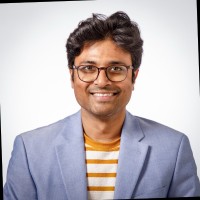
AeroLeads people directory · profile
Joyjit Kundu Email & Phone Number
R and D Manager and Principal Member of Technical Staff + Team Lead
at
imec
1 work email found
@imec.be
LinkedIn matched
✓ Verified Jul 2026
4 data sources
Profile completeness 86%
Current company
Role
R and D Manager and Principal Member of Technical Staff + Team Lead
Location
Leuven, Flemish Region, Belgium
Company size
Who is Joyjit Kundu? Overview
A concise factual answer block for searchers comparing this professional profile.
Quick answer
Joyjit Kundu is listed as R and D Manager and Principal Member of Technical Staff + Team Lead at imec, a with 2817 employees, based in Leuven, Flemish Region, Belgium. AeroLeads shows a work email signal at imec.be and a matched LinkedIn profile for Joyjit Kundu.
Joyjit Kundu previously worked as Senior Research Scientist at Imec and Assistant Professor at Indian Institute Of Technology, Hyderabad. Joyjit Kundu studied at Berkeley Lab.
Company email context
Email format at imec
This section adds company-level context without repeating Joyjit Kundu's masked contact details.
{first}.{last}@imec.be
89% confidence
AeroLeads found 1 current-domain work email signal for Joyjit Kundu. Compare company email patterns before reaching out.
Profile bio
About Joyjit Kundu
Summary: Performance modeling (e.g., LLM training and inference for gpus, tpus, novel architectures), Molecular Simulations for Drug Discovery, AI accelerated physics simulations (e.g., CFD), Digital twins, Performance analysis of large-scale machine learning and scientific workloads; kernel writing.Background: Computational physicist by training.Key Competencies:• AI accelerated simulation, Machine Learning, Performance modeling and analysis of ML & HPC workloads, HW-SW co-design. • Research experience in Statistical mechanics, soft-matter physics, material science, disordered systems• High performance computing: CUDA C for GPU, MPI, openMP.• C, Python, Dlang, Mathematica, Matlab.• Data analysis.• Algorithms.• Mathematical modeling.• Scientific computing: Monte Carlo, Molecular dynamics, biomolecular simulations, Computational Fluid Dynamics (CFD).• Coarse-grained and all-atom simulations (e.g GROMACS, NAMD, VASP). Keywords:** Computer simulations ** Machine Learning** High Performance Computing ** Performance modeling ** GPU, MPI, OpenMP ** Monte Carlo ** Machine and Deep Learning ** Data Analysis ** Molecular dynamics ** Bio-molecular simulations ** Free energy calculations ** Phase Transitions ** Algorithms ** Theoretical modeling ** Porous Materials ** Gas separation ** Adsorption ** Gas transport ** Disordered Systems ** Glass** Thermodynamics ** Statistical Mechanics ** Condensed matter physics **
Current workplace
Joyjit Kundu's current company
Company context helps verify the profile and gives searchers a useful next step.
Imec
8 roles
Joyjit Kundu work experience
A career timeline built from the work history available for this profile.
Senior Research Scientist
- Performance modelling and optimization of Machine learning (e.g., LLM inference, training) + HPC workloads- AI accelerated physics simulations- Molecular dynamics + ML for Drug Discovery

Assistant Professor
Dec 2019 - Jan 2022

Postdoctoral Fellow
Supported by Simons Collaboration on Cracking the Glass Problem.Advisor: Dr. Patrick Charbonneau, Dr. Ludovic BerthierAlthough amorphous materials such as grains, bubbles, foams, glasses are ubiquitous in nature, their complete theoretical description remains one of the unsolved fundamental problems in theoretical condensed-matter physics. On the molecular scale, the structure of a glass resembles that of a liquid, however, they do not flow, thus, behaves like a solid. Developing a theoretical description of such systems is notoriously difficult as the conventional techniques fail. The problem is solvable in the infinite dimensional limit, but the phenomenology is quite different in physical dimensions. Many systems in fields as diverse as computer science, neuroscience, biology and information theory exhibit a phenomenology akin to glassiness and will benefit from our advances. • using numerical simulations to bridge the gap between the infinite dimensional limit and the physical dimensions. • developed statistical mechanical models of glass forming liquid.• developed Monte Carlo codes to simulate systems of polydisperse hard sphere fluids in different spatial dimensions.• implemented the swap algorithm that has recently been very successful to simulate glassy systems. • optimized various parameters (e.g. polydispersity, swap probability) to obtain the best performance in various spatial dimensions. • developed scripts for analyzing the trajectories and measuring different observables to understand the dynamic and statistical properties (e.g pair correlation, overlap function, fluctuations). • research articles in preparation.
Jul 2017 - Nov 2019

Postdoctoral Fellow
Supported by UC Berkeley’s Center for Gas Separations Relevant to Clean Energy Technologies, an Energy Frontier Research Center and The Soft Matter Electron Microscopy ProgramAdvisor: Dr. Stephen Whitelam, Dr. David PrendergastDeveloping technologies for gas separation and storage are crucial for clean, renewable energy and various industrial applications. Metal organic frameworks (MOFs), a class of porous crystalline materials with largely tunable properties and huge surface area, are promising candidates in this regard. • developed statistical mechanical models of gas uptake within porous media.• collaborated with experimentalists to build coarse-grained simulation models. • developed kinetic Monte Carlo codes to simulate the model systems.• performed multi-scale simulations to parametrize the model and measured important thermodynamic and dynamic observables related to gas uptake.• used tools of statistical physics to understand the physical properties.• proposed strategies for selective gas capture under nonequilibrium conditions. • explained the physics of cooperative adsorption in MOFs.• came up with exact solution of a model of cooperative adsorption. • published research articles (see Publications)The assembly of sequence-defined polymers into ordered nanostructures opens up a class of well- defined protein-mimetic materials with complex functions such as catalysis and molecular recognition. Specific arrangement of different functional groups in a peptoide leads them to self-assemble in different structures like nano sheets, nanotubes. • constructed atomistic models of self-assembled peptoid nanostructures (e.g. nanosheet).• performed all-atom molecular dynamics simulations to understand self-assembly mechanism.• computed free enrergy of the cis, and the trans conformations using 2-Phase Thermodynamics Method.• discovered the molecular structure and arrangement within the nanostructures.• published research articles (see Publications)
Jul 2015 - Jun 2017
Phd In Theoretical Physics
The Institute Of Mathematical Sciences (Imsc),Chennai
Advisor: Dr. R. RajeshEntropy-driven phase transitions are interesting and counter-intuitive as they lead to increase in visible order with gain in entropy. Systems exhibiting entropy-driven transitions include colloids of polymethyl methacrylate (PMMA), tobacco mosaic virus, fd virus, silica particles, boehmite particles, and Brownian platelets. Hard-core lattice gas models or systems with only excluded volume interactions on lattices are minimal models to study entropy-driven ordering transitions. • studied the phase transitions in systems of hard rectangles/rods on lattices.• developed a new, efficient and highly parallelizable Monte Carlo algorithm with nonlocal moves.• developed Monte Carlo codes to perform simulations for the model of hard rectangles of arbitrary size on lattices.• developed GPU version of the code with CUDA C.• adapted MPI and openMP versions of the code. • discovered different phases, phase diagrams, detailed nature of the phase transitions.• performed free energy calculations using thermodynamic integration and entropy estimations to obtain phase diagrams.• developed codes and scripts to analyze the data.• studied different limits of the problem using various analytical techniques such as mean filed theory, viral expansion, high density perturbation expansion.• solved the model of rods exactly on a Bethe- like lattice.• published research articles (see Publications).
Aug 2010 - Feb 2015

Master Thesis
Advisor: Prof. Prasanta Kumar Tripathy• worked on developments in Cosmology.• studied Hořava–Lifshitz gravity.
Aug 2009 - Jul 2010

Research Internship
Advisor: Dr. Manoranjan P. SinghCoherent Population Trapping (CPT) is a phenomenon occurring due to the coherent effect of atom-field interaction. If the atoms are prepared in coherent superposition states, it is possible to cancel the absorption or emission under certain conditions. These atoms are then effectively transparent to the incident field even in the presence of resonant transition. The cause of the modified optical response of an optical medium is the laser induced coherence of atomic states, which leads to quantum interference between the excitation pathways that controls the optical response. In this way the absorption and refraction of the medium can be modified. Electromagnetically Induced Transparency (EIT) is a method eliminating the effects of a medium on a propagating beam of electromagnetic radiation. It gives rise to greatly enhanced nonlinear susceptibility in the spectral region of induced transparency of the medium and is associated with steep dispersion. • studied light-atom interaction for various atomic systems.• examined Coherent Population Trapping (CPT) and Electromagnetically Induced Transparency (EIT) for multi-level systems.• used semi classical approach where the atoms are treated quantum mechanically and the field is treated classically. • derived various aspects of CPT and EIT to understand enhancement of refractive index with low absorption, pulse storage and information processing, propagation of pulse without distortion, and lasing without inversion.
May 2009 - Jul 2009
Team & coworkers
Colleagues at imec
Other employees you can reach at imec.be. View company contacts for 2817 employees →
SE
 Saeedeh Ebrahimi Takalloo
Colleague at ImecLeuven, Flemish Region, Belgium
View →
JZ
Saeedeh Ebrahimi Takalloo
Colleague at ImecLeuven, Flemish Region, Belgium
View →
JZ
 Jing Zhang
Colleague at ImecGhent, Flemish Region, Belgium
View →
KH
Jing Zhang
Colleague at ImecGhent, Flemish Region, Belgium
View →
KH
 Koen Huybrechts
Colleague at ImecLeuven, Flemish Region, Belgium
View →
ID
Koen Huybrechts
Colleague at ImecLeuven, Flemish Region, Belgium
View →
ID
 Ivano De Ciantis
Colleague at ImecBielsko-Biała Metropolitan Area, Poland
View →
OW
Ivano De Ciantis
Colleague at ImecBielsko-Biała Metropolitan Area, Poland
View →
OW
 Olivia Willems
Colleague at ImecGhent, Flemish Region, Belgium
View →
KV
Olivia Willems
Colleague at ImecGhent, Flemish Region, Belgium
View →
KV
 Koen Van
Colleague at ImecLimburg, Flemish Region, Belgium
View →
JE
Koen Van
Colleague at ImecLimburg, Flemish Region, Belgium
View →
JE
 Juan Esteban Z.
Colleague at ImecLeuven, Flemish Region, Belgium
View →
SH
Juan Esteban Z.
Colleague at ImecLeuven, Flemish Region, Belgium
View →
SH
 Sandip Halder
Colleague at ImecAntwerp Metropolitan Area, Belgium
View →
GL
Sandip Halder
Colleague at ImecAntwerp Metropolitan Area, Belgium
View →
GL
 Geert Langereis
Colleague at ImecEindhoven, North Brabant, Netherlands
View →
BG
Geert Langereis
Colleague at ImecEindhoven, North Brabant, Netherlands
View →
BG
 Bala Guru
Colleague at ImecUnited Arab Emirates
View →
Bala Guru
Colleague at ImecUnited Arab Emirates
View →
Saeedeh Ebrahimi Takalloo
Colleague at ImecLeuven, Flemish Region, Belgium
View →
JZ
Jing Zhang
Colleague at ImecGhent, Flemish Region, Belgium
View →
KH
Koen Huybrechts
Colleague at ImecLeuven, Flemish Region, Belgium
View →
ID
Ivano De Ciantis
Colleague at ImecBielsko-Biała Metropolitan Area, Poland
View →
OW
Olivia Willems
Colleague at ImecGhent, Flemish Region, Belgium
View →
KV
Koen Van
Colleague at ImecLimburg, Flemish Region, Belgium
View →
JE
Juan Esteban Z.
Colleague at ImecLeuven, Flemish Region, Belgium
View →
SH
Sandip Halder
Colleague at ImecAntwerp Metropolitan Area, Belgium
View →
GL
Geert Langereis
Colleague at ImecEindhoven, North Brabant, Netherlands
View →
BG
Bala Guru
Colleague at ImecUnited Arab Emirates
View →
6 education records
Joyjit Kundu education
Education record
Berkeley Lab
Education record
Lawrence Berkeley National Laboratory
Doctor Of Philosophy - Phd, Theoretical And Mathematical Physics
The Institute Of Mathematical Sciences (Imsc),Chennai
Master'S Degree, Physical Sciences, Ranked 4Th In The Class.

Bachelor'S Degree, Physical Sciences
Education record
FAQ
Frequently asked questions about Joyjit Kundu
Quick answers generated from the profile data available on this page.
What company does Joyjit Kundu work for?
Joyjit Kundu works for imec.
What is Joyjit Kundu's role at imec?
Joyjit Kundu is listed as R and D Manager and Principal Member of Technical Staff + Team Lead at imec.
What is Joyjit Kundu's email address?
AeroLeads has found 1 work email signal at @imec.be for Joyjit Kundu at imec.
Where is Joyjit Kundu based?
Joyjit Kundu is based in Leuven, Flemish Region, Belgium while working with imec.
What companies has Joyjit Kundu worked for?
Joyjit Kundu has worked for Imec, Indian Institute Of Technology, Hyderabad, Duke University, Berkeley Lab, and The Institute Of Mathematical Sciences (Imsc),Chennai.
Who are Joyjit Kundu's colleagues at imec?
Joyjit Kundu's colleagues at imec include Saeedeh Ebrahimi Takalloo, Jing Zhang, Koen Huybrechts, Ivano De Ciantis, and Olivia Willems.
How can I contact Joyjit Kundu?
You can use AeroLeads to view verified contact signals for Joyjit Kundu at imec, including work email, phone, and LinkedIn data when available.
What schools did Joyjit Kundu attend?
Joyjit Kundu studied at Berkeley Lab.
Find 750M verified contacts
Search by job title, company, industry, location, and seniority. Export verified B2B contact data when you need it.
Start free trialPeople with similar names
Check these profiles if this is not the Joyjit Kundu you were looking for.
View similar profiles