
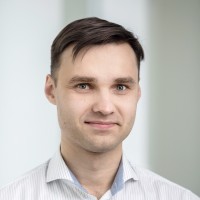
AeroLeads people directory · profile
Roberts Rimsa Email & Phone Number
CTO and Co-founder
at
Cellbox Labs
LinkedIn matched
✓ Verified July 2026
3 data sources
Profile completeness 100%
Current company
Role
CTO and Co-founder
Location
Riga, Latvia
Company size
Who is Roberts Rimsa? Overview
A concise factual answer block for searchers comparing this professional profile.
Quick answer
Roberts Rimsa is listed as CTO and Co-founder at Cellbox Labs, a with 13 employees, based in Riga, Latvia. AeroLeads shows a matched LinkedIn profile for Roberts Rimsa.
Roberts Rimsa previously worked as CTO & Co-founder at Cellbox Labs and Leading Researcher at Institute Of Solid State Physics, University Of Latvia (Issp Ul). Roberts Rimsa holds Doctor Of Philosophy (Phd), Centre For Doctoral Training In Molecular Scale Engineering from University Of Leeds.
Company email context
Email format at Cellbox Labs
This section adds company-level context without repeating Roberts Rimsa's masked contact details.
Cellbox Labs
Review company-level records connected to Roberts Rimsa before choosing the right outreach path.
Profile bio
About Roberts Rimsa
I'm the Co-founder and CTO of Cellbox Labs, where I apply my PhD knowledge in microfluidics to create innovative organ-on-chip technology. My role is a blend of academic research and practical industry application, focusing on advancing microfluidic techniques. With a background that spans both academia and industry in various countries, I'm dedicated to driving forward the field of microfluidics, always open to new ideas and collaborations.
Listed skills include Nanotechnology, Physics, Research, Nanoparticles, and 21 others.
Current workplace
Roberts Rimsa's current company
Company context helps verify the profile and gives searchers a useful next step.
Cellbox Labs
7 roles
Roberts Rimsa work experience
A career timeline built from the work history available for this profile.
Cto & Co-Founder
Cellbox Labs is developing miniature human organ replicas to help pharmaceutical companies to perform preclinical tests in human-like organs. We use material and fabrication methods of microfluidic chips that are superior to an existing solution since they are suitable for mass manufacturing and drug testing. As the CTO, I am leading the team in microfluidic chip and complementary instrument development.

Leading Researcher
I am currently involved in microfluidic project development with a focus on organ-on-chip device concept design and fabrication utilising mass-manufacturable techniques. Throughout my tenure at ISSP UL I have participated in attracting 1.07 M EUR of funding to the host institution in the last 3 years. I have also been one of the inventors for a European patent application related to organ on chip devices.

Microfluidics Engineer
I was involved in the design and the development of disposable microfluidic cartridges and sample collection devices for the diagnostic tests that QuantuMDx is developing. My key responsibilities included the principle design and prototyping of various microfluidic circuit elements that will be utilised in the next, mass-produced disposable microfluidic cartridge. I was the technical lead in three of seven work packages related to the development of the microfluidic disposable, with a particular focus on the sample preparation and DNA concentration stages. As a part of the work package development, I led small teams of up to five people in size. My current work at QuantuMDx has also resulted in filling multiple patent applications and a patent (WO2020109798A1) relating to microfluidic device development.
May 2017 - Jan 2019

Phd Researcher
My PhD was focused on the development of microfluidic chips for medical diagnostics field, particularly biosensors and wearable medical devices. I have a broad experience in microfluidic system design, along with expertise in electromechanical design and fluid dynamics.My hands-on experience in physical device prototyping is ranging from microfabrication in the cleanroom to 3D printing, and CNC machining, and other skills listed below. Along with physical prototyping of the devices, I have gained extensive experience in multiple CAD programs. Through side projects, I have worked on designing master molds for disposable injection molded chips, giving me experience in design for manufacturing.The key achievements from my PhD:» Designed, fabricated and characterised a piezoelectric-based micropump with 10x higher efficiency than previously reported. Publication in progress.» Developed a protocol for three-dimensional microfluidic channel fabrication with 50x reduction in cost and 3x reduction in time comparing to standard cleanroom manufacturing protocol» Built a device that incorporates multi-channel RF signal generating and amplifying in a single design, consequently decreasing the footprint of the device 3 times, and lowering the cost of the setup 50x.» Participated in 3 side-projects assisting with microfluidic system design, along with the mechanical design of flow cells, and disposable microfluidic chips. Resulting in a publication in the Scientific Reports.My skills:» Rapid prototyping:・Microfabrication ・Wet and dry etching ・3D printing ・Soft-lithography・CNC machining ・Laser cutting»Electronics:・High-frequency circuitry ・Network analysers ・Amplifiers ・PCB design»Microfluidics:・Medical device design ・PDMS based systems ・SU8/Glass based systems»Software skills:・Solidworks ・Tanner L-edit ・Eagle PCB ・Microwave Office ・Simplify3D ・Origin Pro ・Python ・MS Office suite
Sep 2013 - May 2017
Undergraduate Research Assistant
This summer internship was carried out in Professor Andrew Nelson’s research group at the School of Chemistry. The main focus was the study of nanoparticle interactions with phospholipid monolayers. This was achieved by using Rapid Cyclic Voltammetry (RCV) to form monolayers on electrodes, further monolayer permeability to nanoparticles was investigated using Scanning Electron Microscopy (SEM) and Scanning Tunnelling Microscopy (STM). Main outcomes from this internship were redesigned and improved experimental setup which allows to investigate samples using STM, which previously was not possible, and basic conductivity data of phospholipid monolayers. The internship was carried out as a part of the Nuffield Science Bursary award.
Jun 2012 - Aug 2012

Undergraduate Research Assistant
This internship was carried out in Prof. Medvid’s research group at the Institute of Technical Physics. Goal of this internship was to study the effect of crystal defect migration in Ge after laser radiation. This was achieved by obtaining current-voltage characteristics of chemically treated and/or laser-irradiated Ge single crystal samples. irradiation was done with first, second and fourth harmonic of Nd:YAG laser. Based on data acquired during this internship a publication in Nanoscale Research Letters (impact factor: 2.481) was made.
Jun 2011 - Aug 2011
2 education records
Roberts Rimsa education
Doctor Of Philosophy (Phd), Centre For Doctoral Training In Molecular Scale Engineering
Bachelor Of Science (Bsc), Nanotechnology, First Class
FAQ
Frequently asked questions about Roberts Rimsa
Quick answers generated from the profile data available on this page.
What company does Roberts Rimsa work for?
Roberts Rimsa works for Cellbox Labs.
What is Roberts Rimsa's role at Cellbox Labs?
Roberts Rimsa is listed as CTO and Co-founder at Cellbox Labs.
Where is Roberts Rimsa based?
Roberts Rimsa is based in Riga, Latvia while working with Cellbox Labs.
What companies has Roberts Rimsa worked for?
Roberts Rimsa has worked for Cellbox Labs, Institute Of Solid State Physics, University Of Latvia (Issp Ul), Quantumdx Group Limited, University Of Leeds, and Riga Technical University.
How can I contact Roberts Rimsa?
You can use AeroLeads to view verified contact signals for Roberts Rimsa at Cellbox Labs, including work email, phone, and LinkedIn data when available.
What schools did Roberts Rimsa attend?
Roberts Rimsa holds Doctor Of Philosophy (Phd), Centre For Doctoral Training In Molecular Scale Engineering from University Of Leeds.
What skills is Roberts Rimsa known for?
Roberts Rimsa is listed with skills including Nanotechnology, Physics, Research, Nanoparticles, Microfabrication, Science, Microfluidics, and 3D Printing.
Find 750M verified contacts
Search by job title, company, industry, location, and seniority. Export verified B2B contact data when you need it.
Start free trialPeople with similar names
Check these profiles if this is not the Roberts Rimsa you were looking for.
Roberts Rimsa
1 email domain