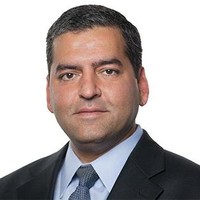
Vikram Mehta earned M.Sc. in Physics from Gujarat University, India in 1977; Post-graduate Diploma in Space Sciences and Their Applications from Gujarat University in 1979; and was an Indian Space Research Organization (ISRO) Research Fellow at Space Applications Centre, ISRO, Ahmedabad, India from 1979 to 1982 working on Microwave Remote Sensing. He then studied Upper Atmosphere Physics at the University of Saskatchewan in Canada from 1982 to 1984, earning a Post-Graduate Diploma in Physics. A strong interest in more applications-oriented scientific research led him to Department of Meteorology at Florida State University in Tallahassee, Florida, where he earned M.S. degree in 1986 and Ph.D. degree in Meteorology in 1990. Vikram was then a research scientist for 12 years in NASA-Goddard Space Flight Center, further specializing in decadal climate variability (DCV). Strongly motivated to use climate science for societal benefits, Vikram founded the Center for Research on the Changing Earth System (CRCES), a non-profit, scientific research organization in 2002. Currently, he is the Executive Director of CRCES, which is funded by grants from NASA, NOAA, and USDA for research and other activities on DCV and its societal impacts. Vikram has worked extensively on assessing, modeling, and predicting DCV impacts on water resources, agriculture, and water-borne transportation in the Missouri and Mississippi River Basins. His book on worldwide impacts of DCV on water resources, agriculture, water-borne transportation, fisheries, and socio-economic and political consequences was published by CRC Press in 2017. His book titled "Natural Decadal Climate Variability: Phenomena, Mechanisms, and Predictability" was published by CRC Press in November 2020. Vikram’s major research interests are understanding and prediction of DCV and its impacts on water resources, agriculture, public health, and the economy; and climate and public policy. Vikram has also published over 150 research papers and Conference/Workshop presentations.Beginning in the 2021-22 academic year, Vikram is a Visiting Professor in the Indian Institute of Technology-Delhi (IITD)'s Centre for Atmospheric Sciences (CAS) in New Delhi, India. In January-February 2022, Vikram taught a course on Decadal Climate Variability and Predictabiity to Master's and PhD students. He is also mentoring PhD students, teaching a course "An Introduction to Adaptation Sciences" in January-February 2023, and working with IITD faculty in setting up a Centre of Excellence in Adaptation.
Listed skills include Environmental Science, Climate Change, Data Analysis, Science, and 16 others.