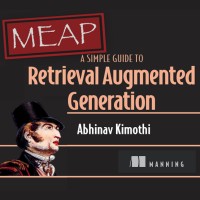
A Simple Guide to Retrieval Augmented Generation Overview
- Website
- mng.bz
- Industry
- Book Publishing
- Employees
- 1
- Founded
- 2024
- NAICS
-
Book Publishers
About A Simple Guide to Retrieval Augmented Generation
Generative AI models struggle when you ask them about facts not covered in their training data. Retrieval Augmented Generation—or RAG—enhances an LLM’s available data by adding context from an external knowledge base, so it can answer accurately about proprietary content, recent information, and even live conversations. RAG is powerful, and with A Simple Guide to Retrieval Augmented Generation, it’s also easy to understand and implement! In A Simple Guide to Retrieval Augmented Generation you’ll learn: The components of a RAG system How to create a RAG knowledge base The indexing and generation pipeline Evaluating a RAG systems Advanced RAG strategies RAG tools, technologies and frameworks A Simple Guide to Retrieval Augmented Generation shows you how to enhance an LLM with relevant data, increasing factual accuracy and reducing hallucination. Your customer service chatbots can quote your company’s policies, your teaching tools can draw directly from your syllabus, and your work assistants can access your organization’s minutes, notes, and files. about the book A Simple Guide to Retrieval Augmented Generation makes RAG simple and easy, even if you’ve never worked with LLMs before. This book goes deeper than any blog or YouTube tutorial, covering fundamental RAG concepts that are essential for building LLM based applications. You’ll be introduced to the idea of RAG and be guided from the basics on to advanced and modularized RAG approaches—plus hands-on code snippets leveraging LangChain, OpenAI, Transformers and other Python libraries. Chapter-by-chapter, you’ll build a complete RAG-enabled system and evaluate its effectiveness. You’ll compare and combine accuracy-improving approaches for different components of RAG, and see what the future holds for RAG. You’ll also get a sense of the different tools and technologies available to implement RAG. By the time you’re done reading, you’ll be ready to start building RAG enabled systems.
Compare Similar Companies to A Simple Guide to Retrieval Augmented Generation
Anthropic
Research Services
Sigmoid
Business Consulting And Services
Towards Data Science
Internet Publishing
Manning Publications Co.
Book And Periodical Publishing
LlamaIndex
Technology, Information And Internet
Yarnit
Technology, Information And Internet
Langflow
Software Development
Mastering LLM (Large Language Model)
Education
Knowledgator
Software Development
TekStudy
E-Learning Providers